
The Respiratory Diaphragm: A Centre of Unity Within the Human Body
Jun 02, 2026Ask an osteopath about the respiratory diaphragm and most will immediately talk about breathing.
Inhalation, exhalation, rib movement, lung expansion etc. All of these are important.
But what if the respiratory diaphragm is one of the most important organising structures in the entire human body?
What if it influences circulation, lymphatic drainage, visceral motion, autonomic balance, spinal mechanics and movement throughout the whole system?
What if many of the restrictions we feel through the thorax, abdomen, spine and pelvis are not simply local problems at all, but expressions of altered diaphragmatic relationships?
If A.T. Still encouraged us to view the body as a unit, then the respiratory diaphragm may be one of the clearest demonstrations of that principle. For me, it remains one of the most fascinating and underestimated structures in osteopathic practice.
Why the Respiratory Diaphragm Matters in Osteopathy
The respiratory diaphragm is one of the most familiar structures in osteopathic manual medicine and osteopathic manipulative treatment (OMT). Every osteopath learns its anatomy, understands its role in respiration and will undoubtedly assess and treat it throughout their career.
Yet despite this familiarity, I often think the diaphragm remains one of the most underestimated structures within the body. When most practitioners think about the diaphragm, they naturally think about breathing. Whilst respiration is undeniably important, it only tells part of the story.
From an osteopathic perspective, the diaphragm is far more than a muscle of inspiration. It is a meeting place where circulation, neurology, mechanics, visceral function and movement all intersect. Situated between the thorax and abdomen, the diaphragm occupies a remarkable position within the body. Superiorly it relates to the lungs, pleura and heart. Inferiorly it is intimately connected with the liver, stomach, spleen, mesentery and abdominal viscera. Passing through and around it are major blood vessels, lymphatic pathways and important neurological structures.
Every breath influences pressure relationships throughout the thoracic and abdominal cavities and, in doing so, influences circulation, fluid movement and mechanical function throughout the body.
Perhaps this is why generations of osteopaths have paid such close attention to diaphragmatic function. Not because they viewed the diaphragm in isolation, but because they recognised its influence upon the wider system.
The Embryological Story of the Diaphragm
One of the reasons I find the diaphragm so fascinating is its developmental history.
Unlike many structures that arise from a single embryological source, the diaphragm develops from several distinct components which gradually come together during development.
Long before it becomes a respiratory muscle, it is acting as an organiser of space and relationship. As it descends into its adult position it carries its nerve supply with it, creating the well-known connection with the phrenic nerve and cervical spine. For me, this is more than simply an anatomical fact. It serves as a reminder that many of the relationships we observe clinically have deep developmental roots.
When we see connections between cervical tension, breathing patterns, thoracic inlet restriction and diaphragmatic behaviour, we are observing relationships that have existed since the earliest stages of development.
This embryological story also reinforces one of the fundamental principles of osteopathy. The body does not develop as a collection of separate parts that later learn to communicate with one another.
Rather, it develops as an integrated whole and retains those relationships throughout life. The diaphragm sits at the centre of many of these relationships, linking the neck to the thorax, the thorax to the abdomen and structure to function in a way that few other tissues do.
The Anatomy of Relationship
Most anatomy texts describe the diaphragm through its origins and insertions.
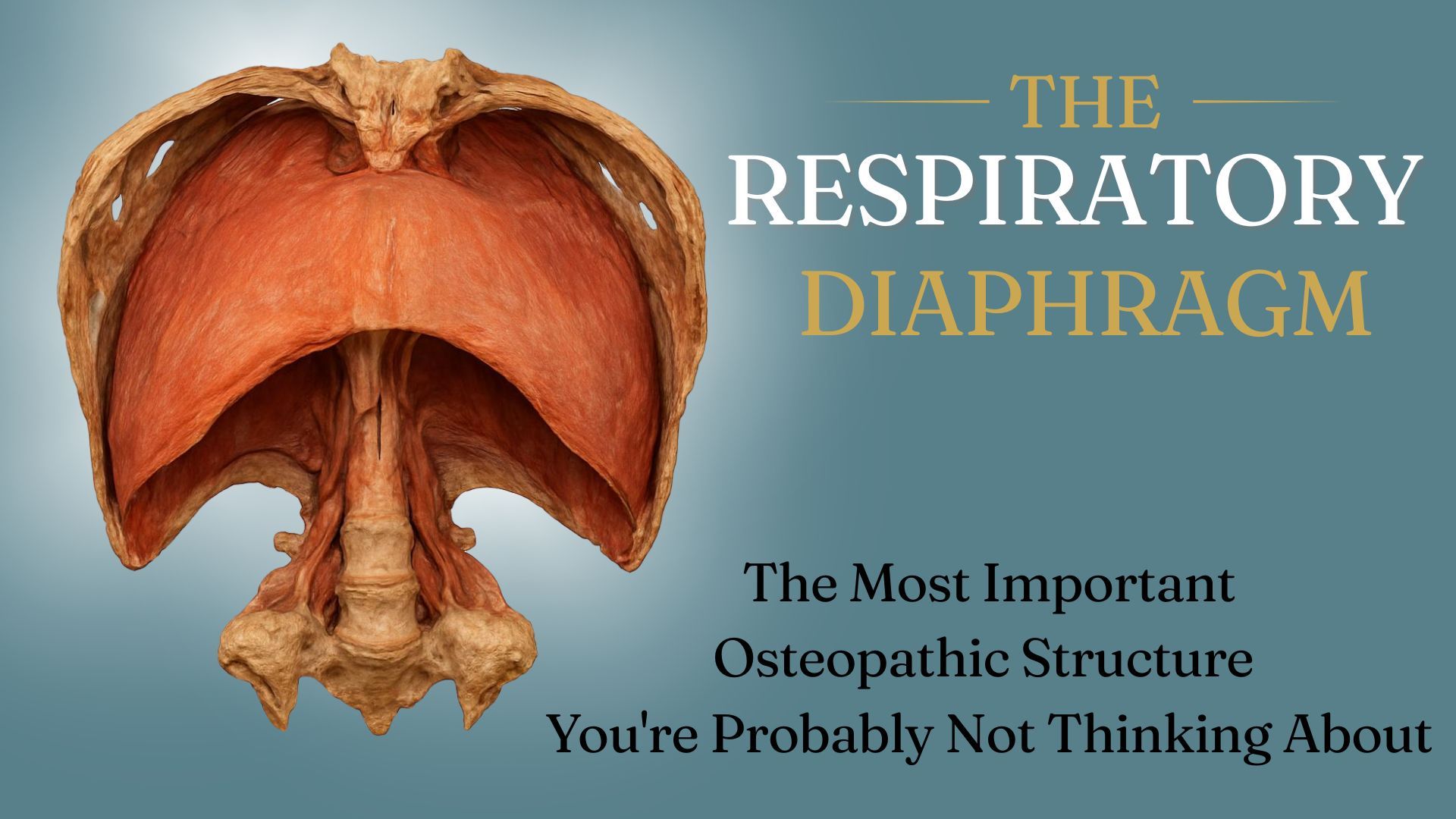
We learn about the costal fibres attaching to the inner surfaces of the lower ribs, the sternal fibres arising from the xiphoid process and the lumbar fibres attaching through the crura to the upper lumbar vertebrae. Whilst these descriptions are anatomically accurate, they can sometimes encourage us to view the diaphragm as an isolated structure.
In reality, the diaphragm exists within an extensive network of fascial, visceral, vascular and neurological relationships. The central tendon, for example, is intimately related to the fibrous pericardium. Every breath therefore has a mechanical relationship with the heart. The crura create direct connections between the diaphragm, lumbar spine and oesophagus. Superiorly the diaphragm relates to the pleura and endothoracic fascia, whilst inferiorly it blends into the fascial and visceral environment of the abdomen.
Viewed in this way, the diaphragm is not simply attached to surrounding structures. It is integrated with them.
The Diaphragm and Circulation
Perhaps nowhere is this integration more apparent than when we consider the structures that pass through the diaphragm.
The inferior vena cava passes through the caval opening. The oesophagus and vagal trunks pass through the oesophageal hiatus. The aorta and thoracic duct pass through the aortic hiatus. These are not simply holes within a muscle. They remind us that the diaphragm occupies a strategic position at the crossroads of circulation, digestion, lymphatic drainage and autonomic regulation.
This is one reason why the diaphragm has traditionally occupied such an important place within osteopathic treatment and osteopathic manipulative medicine (OMM).
A.T. Still repeatedly emphasised the importance of circulation and fluid movement. Every breath contributes to venous return, lymphatic drainage and pressure regulation throughout the thoracoabdominal cavity. During inhalation, the diaphragm descends, increasing intra-abdominal pressure whilst reducing intrathoracic pressure. This pressure gradient assists the movement of blood and lymph back towards the heart. The diaphragm therefore functions as one of the body's most powerful circulatory pumps.
Beyond Anatomy Exams
Many undergraduate programmes encourage students to learn the anatomy of the diaphragm well enough to pass an examination. Once qualified, however, many practitioners stop revisiting the deeper anatomical relationships. Clinical discussions often become dominated by symptoms, diagnoses and orthopaedic tests.
Yet an osteopath can only reason from their understanding of anatomy and relationship. If we lose sight of anatomy, we lose sight of the very thing that allows us to understand why tissues adapt, compensate and reorganise.
The diaphragm reminds us that anatomy is not simply something to pass an exam. It is the language through which we understand the patient.
Why Diaphragm Restriction Is Rarely the Primary Problem
From an osteopathic perspective, the more interesting question is not how the diaphragm moves when healthy, but what happens when its movement becomes restricted.
A loss of diaphragmatic excursion may influence venous return, alter lymphatic drainage, affect pressure regulation and change the way forces are transmitted throughout the trunk.
This is a whole-body issue.
One of the most important lessons the diaphragm has taught me over the years is that the most obvious restriction is not always the primary problem. When we encounter a diaphragm that feels restricted, dense or guarded, there can be a temptation to immediately focus our attention there.
However, the diaphragm is often reflecting adaptation elsewhere within the system. It may be responding to abdominal tension, thoracic rigidity, previous surgery, chronic pain or prolonged stress.
Rather than asking how we can release the diaphragm, it is often more useful to ask why the diaphragm is behaving in this way and what relationship it may be expressing. This shift in thinking fundamentally changes our clinical reasoning.
Instead of viewing the diaphragm as a structure that requires treatment, we begin to view it as a window into the organisation of the patient. A restricted diaphragm may be revealing something about the thoracic cage.
It may be expressing adaptation within the abdominal cavity. It may be responding to altered gait mechanics, a previous scar or changes in autonomic tone. The diaphragm is often less interesting as a structure in itself than as an expression of the wider system.
The Diaphragm, the Liver and the Abdominal Cavity
One relationship that has long fascinated osteopaths is the relationship between the diaphragm and the liver. The right hemidiaphragm sits directly above one of the most vascular organs within the body. Every breath influences the position and movement of the liver and, conversely, changes in liver mobility may influence diaphragmatic behaviour.
This does not mean we reduce every right-sided thoracic problem to the liver. Instead it reminds us to think relationally.
A restricted diaphragm may influence visceral mobility and a restricted viscus may influence diaphragmatic motion. The relationship works in both directions. The same can be said for the diaphragm's relationship with the mesentery and abdominal contents. Every breath creates movement throughout the abdominal cavity. The mesentery is not a passive sheet of tissue. It carries blood vessels, nerves, lymphatics and connective tissue relationships to the intestines.
As the diaphragm descends and rises throughout the day, these structures must continually adapt.
In patients with previous abdominal surgery, chronic constipation, abdominal guarding or inflammatory conditions, the diaphragm may be adapting to a very different mechanical environment.
The Respiratory Diaphragm as a Window Into the Whole Patient
This is where osteopathy becomes far more than the application of technique. It becomes the study of relationship. The diaphragm reminds us that the body is constantly adapting and reorganising itself in response to its internal and external environment.
When we assess a diaphragm, we are not simply assessing a muscle. We are assessing a point of convergence between multiple systems. Perhaps that is why the diaphragm continues to occupy such an important place within osteopathic practice. It embodies many of the principles upon which osteopathy was founded and reminds us that structure and function are inseparable. It demonstrates the importance of circulation, movement and adaptation.
Most importantly, it encourages us to view the patient as a whole rather than as a collection of isolated parts.
What Is the Diaphragm Revealing?
The next time you place your hands upon a patient to assess diaphragmatic function, pause for a moment before asking how much movement is present. Then ask yourself, 'What is this diaphragm revealing about the organisation of the whole person sitting in front of me?'
In many cases, the answer to that question will tell us far more than the restriction itself.
The Respiratory Diaphragm: A Centre of Unity Within the Human Body
The respiratory diaphragm is not simply a muscle of inspiration. It is a centre of organisation.
A centre of circulation, adaptation, relationship.
It links the neck to the thorax. The thorax to the abdomen. The viscera to the musculoskeletal system. Structure to function.
When we assess the diaphragm we are not simply assessing a muscle. We are exploring one of the great meeting places of the human body. Perhaps that is why generations of osteopaths have returned to it again and again because it helps us understand the whole person.
For the osteopath, the respiratory diaphragm provides one of the clearest opportunities to appreciate the body exactly as A.T. Still described it. As a unit.
A living, adapting system in which structure and function are inseparable. Viewed through that lens, the diaphragm becomes far more than a respiratory muscle. It becomes one of the clearest expressions of unity within the human body.
👂Listen to Jamie discuss this topic further on our podcast.
Interested in osteopathic anatomy, osteopathic principles, osteopathic manipulative treatment (OMT), osteopathic manipulative medicine (OMM) and postgraduate osteopathic education?
Explore our articles, podcast and professional training programmes at The Osteopathic Academy of Applied Technique and join osteopaths around the world inside The League of Extraordinary Osteopaths (LXO).
Stay connected with news and updates!
Join our mailing list to receive the latest news and updates from our team.
Don't worry, your information will not be shared.
We hate SPAM. We will never sell your information, for any reason.
