
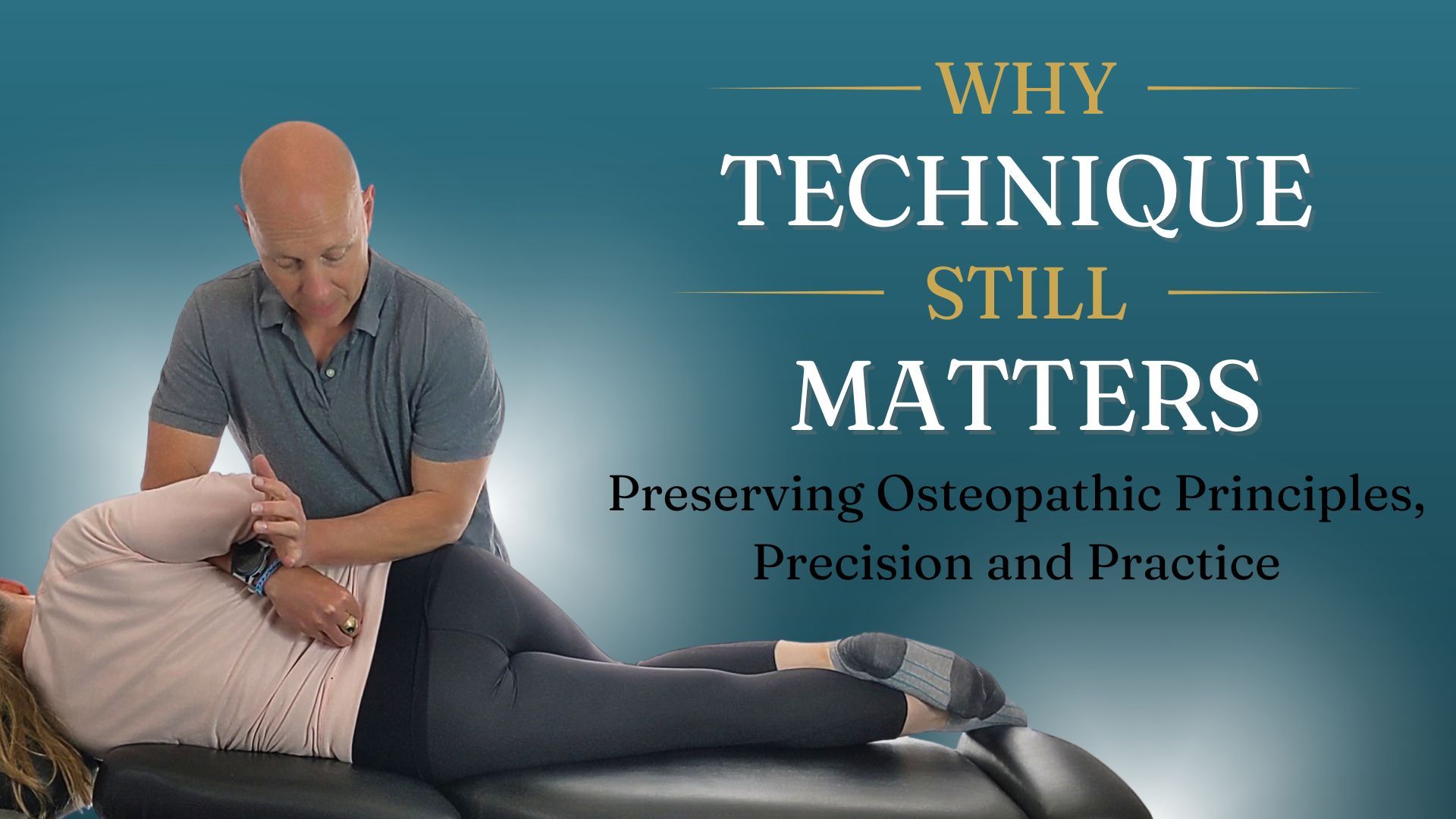
Why Technique Still Matters: Preserving Osteopathic Principles, Precision and Practice
Jun 05, 2026There has been a growing tendency within healthcare to view osteopathic technique as an intervention in its own right, with much of the discussion focused on manipulations, articulations, soft tissue approaches and other hands-on procedures, whilst considerably less attention is given to the principles, anatomy, palpation and clinical reasoning that determine their application. In many cases, the technique becomes the focus of attention, rather than the osteopathic thinking that sits behind it.
In many ways, this has created a fundamental misunderstanding of what osteopathy actually is. One of the most common assumptions is that osteopathy is defined by its techniques, as though the profession can somehow be reduced to a collection of manipulations, articulations and other manual procedures. Yet a manipulation in isolation is simply a manipulation, an articulation in isolation is simply an articulation and an HVLA technique in isolation is simply an HVLA technique. These procedures may influence the body in different ways and may have value when applied appropriately, but they are not osteopathy, not even osteopathic.
Osteopathy was never intended to be a collection of techniques. It was developed as a system of medicine founded upon anatomy, physiology, palpation, clinical reasoning and a set of principles that continue to guide practice today. What makes a technique osteopathic is not the movement that occurs, but the understanding that precedes it. It is the ability to appreciate the patient’s history, recognise meaningful findings, understand the relationships between structure and function and determine whether a particular intervention is appropriate for that individual at that particular moment in time.
However, whilst it is important to recognise that osteopathy is more than technique, it would be equally mistaken to conclude that skilled technique is therefore unimportant. In fact, I would argue the opposite. What the osteopath does with their hands matters enormously and it always has.
Why I Changed My Mind About Technique
Like many osteopaths early in my career, I was fascinated by learning new techniques. If a patient presented with a difficult problem, it was tempting to believe that the answer lay in another course, another manipulation or another method that I had not yet learned. The assumption was that better outcomes would come from acquiring more and more techniques.
Over time, my perspective changed.
The greatest improvements in my clinical outcomes rarely came from learning something entirely new. More often, they came from becoming better at what I already knew. As my understanding of anatomy improved, as my palpatory skills became more refined and as my clinical reasoning developed, osteopathic manipulative techniques that I had been using for years often produced very different results.
What changed was not the technique itself. What changed was the quality of its application.
This is something that many experienced osteopaths eventually discover. The pursuit of mastery is rarely about finding a secret technique that nobody else knows. More often, it is about becoming more precise, more specific and more skilful in the application of the techniques already within your repertoire.
The Difference Between Competence and Mastery
Generations of osteopaths have devoted years, and often entire careers, to refining their osteopathic manipulative treatment skills. They have spent thousands of hours studying anatomy, developing palpatory accuracy, improving positioning, refining localisation and learning how to apply force with greater precision and control. This commitment exists because experienced practitioners understand something that is often overlooked in modern discussions, namely that there is a profound difference between performing a technique and mastering a technique.
The public often sees only the final intervention. They see a lumbar roll, a rib articulation or a cervical manipulation and understandably assume that the technique itself is the treatment. What they do not see are the years spent deliberately developing the judgement required to decide whether that technique is appropriate, the palpatory skills required to identify the relevant tissues and the technical refinement required to apply the intervention accurately and effectively.
Anyone can learn the basic mechanics of a technique. Learning where to place your hands, where to position the patient and in which direction movement should occur is relatively straightforward. Learning to perform that same technique with precision, specificity and consistency is something entirely different and requires deliberate practice, reflection, experience and continual refinement.
Most osteopaths can perform a lumbar roll. Far fewer can adapt that lumbar roll to a patient with significant degeneration, altered anatomy, previous surgery, marked guarding, obesity, hypermobility or complex compensatory patterns. To an observer, the technique may appear very similar. In reality, the level of skill required is entirely different.
Every experienced osteopath knows that small details often make a significant difference. The quality of the contact, the positioning of the patient, the localisation of force, the timing of the intervention and the sequencing of treatment can all influence the outcome. Two practitioners may appear to perform the same technique and yet achieve very different results because the quality of its application is fundamentally different.
Why Osteopaths Need More Than a Handful of Techniques
There is a growing narrative within some educational circles that practitioners only need a small number of techniques and that technical variety is largely unnecessary. Whilst there is certainly value in mastering fundamental approaches, patients rarely present with the same anatomy, the same history or the same capacity for adaptation.
The elderly patient with significant degenerative change is unlikely to require the same approach as a young athlete. The patient recovering from abdominal surgery may require a very different sequence of treatment from somebody presenting with an acute cervical complaint. Likewise, a patient with significant anxiety, heightened sensitivity or long-standing illness may require a different approach from someone who responds well to direct intervention.
For this reason, technical versatility remains important. The goal is not to collect techniques for the sake of it, nor is it to accumulate certificates or attend endless courses. The goal is to develop a sufficiently broad technical vocabulary that allows treatment to be adapted to the individual sitting in front of you.
A skilled osteopath does not force the patient to fit the technique. The skilled osteopath adapts the technique to fit the patient.
The Osteopathic Profession Has Always Valued Skilled Hands
When we look back at the history of osteopathy, it becomes clear that technical skill was never considered an optional extra. The founders of osteopathy spent countless hours studying anatomy and developing methods of treatment because they recognised that the hands could become highly sophisticated instruments of assessment and treatment when guided by knowledge and experience.
A.T. Still did not develop osteopathy because he believed technique was unimportant. He developed osteopathy because he believed that skilled hands, guided by a deep understanding of anatomy and physiology, could help remove obstacles to health and allow the body to function more effectively.
The challenge facing modern osteopaths is not deciding whether technique matters. The challenge is ensuring that technique remains connected to the principles from which it emerged.
Without principles, technique becomes routine.
Without anatomy, technique becomes guesswork.
Without palpation, technique loses specificity.
Without clinical reasoning, technique becomes a recipe.
The strength of osteopathy has always been its ability to combine these elements into a coherent system of medicine.
What Happens If We Stop Developing Our Hands?
If technical development becomes secondary, future generations of osteopaths may graduate with excellent communication skills and strong theoretical knowledge, yet lack the confidence and precision required to translate that knowledge into effective treatment.
The profession does not need fewer skilled technicians. It needs osteopaths who combine excellent hands with excellent reasoning.
If we lose sight of technical excellence, osteopathy risks becoming increasingly generic. Treatments become less specific, clinical reasoning becomes less influential and the profession risks being viewed as little more than another form of manual therapy. Yet osteopathy was never intended to be generic. It was intended to be a distinct system of medicine in which anatomy, palpation, reasoning and technique work together in service of the patient.
Preserving the Future of Osteopathy
As a profession, we should continue refining our techniques, teaching them and preserving them. We should continue developing better palpatory skills, better positioning, better localisation and greater technical precision, whilst ensuring that these skills remain grounded in osteopathic principles and sound clinical reasoning.
Osteopathy is not a collection of techniques, but neither is it a profession in which technique no longer matters.
It is a system of medicine that requires both sound clinical reasoning and highly developed OMT skills. The future of osteopathy depends upon preserving both.
Technique still matters because it remains one of the clearest expressions of osteopathic thinking in practice. It is through our hands that anatomy, palpation, reasoning and principle are translated into action. Preserving technical excellence is therefore not about protecting tradition for tradition’s sake. It is about preserving the quality of patient care, maintaining the identity of the profession and ensuring that future generations of osteopaths continue to develop the knowledge, judgement and skill required to practise osteopathy at the highest level.
The responsibility for preserving osteopathy does not belong to colleges, regulators or professional bodies alone. It belongs to every osteopath who continues to study, practice and refine their craft. Through The League of Extraordinary Osteopaths (LXO), we are building a global community dedicated to ensuring that the principles, skills and technical excellence that define osteopathy continue to be passed on to future generations of practitioners.
Join The LXO here: https://www.theappliedtechniquehub.com/the-LXO-membership
Stay connected with news and updates!
Join our mailing list to receive the latest news and updates from our team.
Don't worry, your information will not be shared.
We hate SPAM. We will never sell your information, for any reason.
